Building Skills for Constructive Conversations
At Warren Wilson College, the Progressive Promise commits us to an education grounded in access, experiential learning, and meaningful engagement with the world. The Dialogue Across Difference Initiative extends that promise by preparing students not only to succeed academically, but to engage thoughtfully and courageously across differences in identity, belief, and experience.
This initiative equips students, faculty, and staff with the tools to navigate challenging conversations with curiosity, respect, and intellectual humility—skills essential for leadership, collaboration, and democratic participation.
Our work is informed by national leaders in dialogue and bridge-building, including Resetting the Table, Constructive Dialogue Institute, Interfaith America’s Bridging the Gap curriculum, and Barefoot Dialogue. The initiative is further strengthened through partnership with North Carolina Campus Engagement, including participation in their Student Ambassador programming.
Advancing the Progressive Promise
Dialogue across difference is central to Warren Wilson’s distinctive approach to education. Through this initiative, students:
- Learn by doing through active, practice-based dialogue experiences
- Engage across perspectives as part of a diverse, collaborative community
- Develop skills for impact in their careers, communities, and civic life
- Connect classroom learning with real-world challenges, strengthening their capacity for ethical leadership
4 C's of DxD
Be Curious
Be Charitable
Be Conscientious
Be Constructive
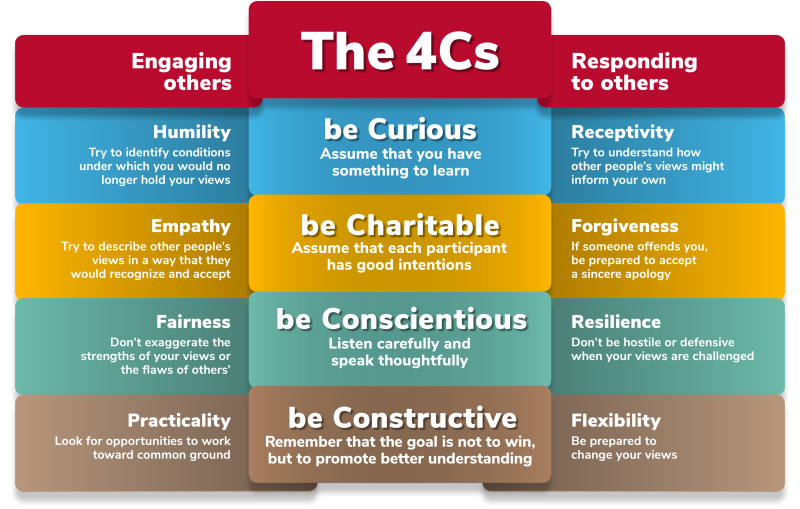
* Image Credit: Ohio State University's Civil Discourse
Programs & Offerings
Orientation Programming
Intentional dialogue experiences are introduced during Orientation, reinforcing from the start our commitment to engaged, respectful community life.
First-Year Seminar (FYS)
A dedicated course grounded in skill-based learning, aligning with the Progressive Promise by integrating academic inquiry with practical communication skills.
Workshops & Trainings
Interactive sessions offering both one-time introductions and multi-session, scaffolded development.
Campus Partnerships
Trainings with athletic teams, work crews, residence halls, and academic classes—embedding dialogue practice across the lived experience of campus. Offerings are flexible, ranging from one-time introductory sessions to sustained, scaffolded training.
NCCE Student Ambassadors
In partnership with North Carolina Campus Engagement, students participate in and contribute to a broader statewide Student Ambassador network focused on civic and community engagement. See WWC's student 2026-2027 student ambassadors below.
Faculty & Staff Development
Support for integrating dialogue practices into teaching, mentoring, and campus programming.
Implementation
To facilitate this work in your classroom, student club, work crew, residence hall floor, athletic team, (or any other group you can think of!) reach out to Shannon Spencer ([email protected]), Chaplain of the College and Director of Spiritual Life, or Evan Snelling, ([email protected]), Director of Inclusive Excellence, to get started.
Resources:
North Carolina Community Engagement (NCCE) Student Ambassadors Program
Warren Wilson is also a partner of North Carolina Community Engagement (NCCE) Student Ambassadors Program
The North Carolina Student Dialogue Ambassadors (SDA) program aims to remedy the current culture of political echo chambers, institutional mistrust, and chronic disconnection through the power of student leadership.
Each year, the SDA program recruits a cohort of three to four campuses in the NCCE network. Each campus selects Student Dialogue Ambassadors and staff/faculty mentors who are trained in multiple formats of dialogue. Then, they host dialogues on their campuses with the goal to create spaces for students to authentically express their views on crucial topics that impact their lives. Since the program’s inception in 2022, eleven campuses have participated.
2026-2027 WWC Student Dialogue Ambassadors:
Sippi Aaij
Rianna Baecher
Additional Resources:
Podcast
Readings:
- Derisa Grant, "On Difficult Discourse"
- Amy Aldridge Sandford, "Confrontation and Avoidance: Alternatives to Civil Discourse"
- William Deresiewicz, "On Political Correctness"
- Amna Khalid and Jeff Snyder, "Yes, DEI Can Erode Free Speech. Let's Not Pretend Otherwise"
- High Conflict by Amanda Ripley
- Why We're Polarized by Ezra Klein
- Righteous Minds: Why Good People are Divided by Politics and Religion by Jonathan Haidt
- Difficult Conversations: How to Discuss What Matters Most by Douglas Stone, Bruce Patton, Sheila Heen
Videos:
Films